Drive Golf Performance Blog
Saturday, 27 December 2025
Reasons To Play Golf
Friday, 10 May 2024
The Card and Pencil Spirit
Wednesday, 15 December 2021
The Last Minute Guide for Non-Golfers Buying Gifts for Golfers
It can be difficult for the non golfer to buy gifts for a golfer but this guide will assist you buying a present every golfer will love. Read on for 10 great gift ideas.
1. The Gift Every Golfer Will Love
Titleist Pro V1 Golf Balls
Every golfer no matter who they are will love the most popular golf ball, the Titleist Pro V1. Head to your closest pro shop to buy. Price ~€60 per dozen.
2. The Gift of an Unforgettable Experience
A Round of Golf
A round of golf at an exceptional course will create enduring and life long memories of a never to be forgotten day. In Ireland Ballybunion, Portmarnock, Waterville, Old Head, Lahinch, Royal County Down, Royal Portrush and others will deliver amazing golfing memories.
Green Fees from €150 upwards.
3. The Gift of Reading
A Classic Book
Golf has an abundance of great books. One of the easiest to read and full of great tips and anecdotes for golfers of all levels is Harvey Penick's Little Red Book, a timeless classic from the 1990's. Other great books include, Golf is not a Game of Perfect - Bob Rotella, Every Shot has a Purpose - Vision 54, The Anatomy of a Golf Course - Tom Doak, Caddy for Life - John Feinstein, Every Shot Counts - Mark Broadie and a new release to consider - A Course Called America - Tom Coyne.
Available from your local book store or to download, Price ~€20
4. The Gift of Better Putting
Every Golfer wants to hole more putts
Training aids are hard to buy because even though every training aid is good for something and someone, very few are good for every one. One of the exceptions to the rule is the Orange Whip Putter Blade. It's flexible shaft design trains putting rhythm, tempo, timing and balance leading to better distance control and face contact which means less putts and lower scores. It works for both right and left handed golfers and is ideal for rolling a few putts on the carpet at home in the Winter time.
Checkout https://orangewhipgolf.com/. Also available with us at Drive Golf Performance
Price: ~€140
5. The Gift of Lower Scores
A Golf Lesson
For the golfer who is already taking lessons, a gift lesson is an easy buy, contact the professional they are getting lessons from and they will know what gift to give.
For the golfer who is not taking lessons, a gift lesson is a bit more difficult to buy as they will have a few reasons, such as little time to practice, as to why they aren't taking lessons. In that situation, a lesson voucher for a distance gapping session, green reading session or playing lesson for strategy would be a great option. The golfer won't have to practice after these sessions and will gain plenty of information to help them shoot lower scores. The professional at the golfer's club will again be able to advise on this.
Golf Lesson Price: €40-€100
6. The Gift of Warmth
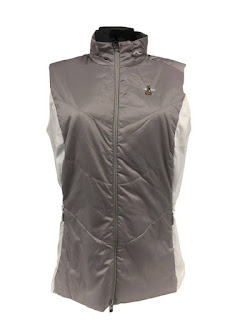
A Kjus Radiation Vest
Clothing items are also a difficult buy but the Kjus Radiation Vest is a gift every one will love. Extra lightweight with windproof and insulating fabric, this vest is as versatile as it gets, perfect for all outdoor activities not just golf. The vest has great freedom of movement and the classic styling will suit everyone.
Available from Waterville Golf Shop with the iconic hare logo.
https://watervillegolflinks.ie/proshop/product/mens-radiation-vest/
7. The Gift of Longer Tee Shots
Extra Speed
Every golfer loves extra distance, the Superspeed Golf over-speed training system will guarantee extra swing speed and distance after a 6 week training program.
Head to https://superspeedgolf.eu/ for more information. The SuperSpeed training system is available too at Drive Golf Performance.
Price: €240
Alternatively if the golfer is thinking of looking at new equipment a club fitting voucher is a great idea. Vouchers can be tailored to meet the needs of the golfer. Contact padraig@drivegolf.info for more information.
Price: From €50
8. The Gift of Organisation
The Gift for the Golfer Who has Everything
For the golfer who has everything, a Mizuno Den Caddy is ideal for organisation in the home office or home practice area. It will stylishly hold everything from golf balls to socks! Den Caddies are in stock at Drive Golf Performance
Price: €95
9. The Gift of Technology
Know Your Distances
There is a plethora of golf technology devices. Range finders and GPS systems are a good buy but the golfer may have one already. A portable launch monitor to measure club distances while practicing is another great option. The PRGR portable launch monitor is accurate for measuring club head speed and ball speed and gives a great distance estimate. PRGR Launch Monitors are in stock at Drive Golf Performance.
Price: €250
10. The Gift to Fill a Stocking
Quick Stocking Fillers
Every golfer will use tees, a sustainable bamboo tee from https://oceanteegolf.com/, will fill up a stocking nicely. Price ~€5
Every golfer likes to stay warm in the winter, a Footjoy retro style bobble hat is also a great stocking filler, visit your local Pro Shop to find a nice head warmer. Price ~€20-€25
Follow Drive Golf Performance on Twitter https://twitter.com/0to300golf, Facebook https://www.facebook.com/DriveGolfPerformance and Instagram https://www.instagram.com/drivegolfperformance for great golf tips, stories and information.
Sunday, 5 December 2021
Don't Grow the Game, Grow the Passion
Thursday, 25 November 2021
The Reasons behind Slow Play in Golf and How to Speed Up.
Slow Play
Nobody likes slow play. Many golfers will cite it as one of the big downsides to golf. What are the reasons behind slow play, is it really the golfer who takes five waggles before every shot and holds up the whole course as a result? Or is there a little more to it?
There are 5 main reasons behind slow play
1. Management Practices and Policies
The
number of golfers on the golf course is the main reason behind slow
play. You're never held up when there's no one out there. As a result
starting times have a big effect on slow play. The quicker groups are
let off the first tee the quicker a course clogs up.
2. Player Behaviour
This
is the one that gets noticed the most. It's time spent between shots
not over shots that's the biggest factor here. Moving slowly between
shots, leaving the bag in the wrong position around the green, not being
ready to play etc. etc.
3. Player Ability
Interestingly
here better players take more time on and around the greens where as
poorer players take more time getting to the green. The worst format for
slow play turns out to be pro-ams, with ams taking a long time to get to the
greens and pros taking forever on the greens.
4. Course Maintenance and Set-up
Longer rough, very fast greens and tougher hole locations all add to the time it takes to play.
5. Course Design
Tougher
courses take longer to play but also the sequence of holes has a big
effect too. Having a difficult long par 3 in the first few holes grinds
the pace of play down.
What can be done about slow play?
The most important thing is action, individual clubs have to take responsibility for the pace of play at their own course and not expect the golfing authorities to do something about it. They have to be willing to sanction slow players and make it clear that slow play is not acceptable. It would seem clubs are unwilling to do this because of the fear of losing some members. However, who is more important? The slow players or the 100 players they're holding up?
It should be noted when talking to golfers about slow play, no one will admit to being slow players themselves. When it's pointed out to fast golfers that they are behind they will just pick up the pace, slow golfers, on the other hand, are quick to argue that they aren't slow and that there's some other reason as to why they are behind.
Also, the golfer's perception influences their thoughts on slow play, if you're not waiting in a 4 hour round no one will complain but if you are waiting continuously in a 4:10 round on the same course it will feel like torture.
What action can be taken?
As there are multiple reasons behind slow play, there is not just one solution that will work. Multiple solutions will be required.
1. Establish a reasonable time for playing the course, this is not going to be the same for every course, a short course with little time walking between greens and tees will take much less time then a big expansive course.
2. Increase the time intervals for starting on the first
tee, remember it's how quickly you finish rather then how quickly you
start is more important. In the 2014 LPGA season average round times decreased by 14 minutes when the starting time intervals were increased to 11 minutes from 10. This means groups can tee off later and finish earlier. The overall number of golfers playing on a daily basis won't diminish greatly as a result.
If a course begins with a par 4 the group in front should either be putting out or finished the hole before the next group tees off. This gives space for golfers to move. Consider faster forms of play too, more matchplay and foursomes should be considered, great to get around the course quickly in winter weather.
Shotgun starts are also great for pace of play if there is only one starting group on a hole, now every group has a free hole in front of them and have space to move into. You'd be surprised how well this can work even with groups of 5 or 6.
3. Educate golfers on how long it takes to get around
and what behaviours are required. It's never a great idea to express
dissatisfaction with someone's behaviour when they're unaware of what's
expected of them. Also it's best to educate golfers as they get into the game, this will give them awareness of how to move at an early stage and also lead to less stress especially when golf is meant to be a relaxing and fun game.
Areas to educate Golfers in:
Awareness - Keep an eye on what is going around your group, noticing that you're 2 holes behind on the 13th is a little late and will put you under pressure, noticing that you're 1/2 hole behind on the 4th is easier to make up.
Move promptly between shots - you can still converse with your playing partners while walking
Ready golf - who ever is ready on the tee should go, the honour system doesn't need to followed always
Bag positioning - leave your bag at the exit of the green closest to the next tee
Proper Tee Markers - play the tees that suit your ability the most, the high handicap trudging back to the back tees can lead to a long day
Score Card Marking - mark your card on the next tee not on the edge of the green just played.
Play a provisional - if playing in a competition play a provisional if the ball might be lost
Prepare early - prepare for your shot while others are hitting, don't wait until it's your turn to hit. The same with putting, look at your line while others are putting.
Move on quickly in casual golf - if you don't find your ball quickly in a casual round, move on and drop a ball further up the hole and finish it out. If it;s taking too many shots to get to the green, also pick up and hit a putt when you get to the green.
Pre-shot routines - one practice swing is more than enough!
Follow the golf ball - keep an eye on where your shot and where your partners shots go, no need to be looking in the wrong place.
4. Sanction golfers who play slowly, e.g they can only play at the end of the field. No exceptions, just because it's the captain's dog walker it doesn't make them exempt from sanction. Also, don't make the sanction too long, 2 weeks or so. The player then gets the opportunity to show their behaviour has changed.
It also is a good idea to give the responsibility to one player in each group to monitor the group's pace of play. This could be the first name on the sheet or lowest handicap or even alphabetically. With the onus on one person they are more likely to speak up if the group is behind.
5. No long rough, nobody likes looking for golf balls. Especially no long rough in blind landing areas and the insides of doglegs. There is nothing worse then looking for a ball in long rough when you can't make out where it landed. Also around hazards, make it clear whether the ball is in or not, no long grass next to hazards. Greens that are too fast lead to too many 3 and even 4 putts adding to the length of the round. Don't have greens speeds that are too fast. Take out trees such as sycamores, which have big leaves that litter, causing hold ups during the Autumn, as well as extra clean up for the course staff.
What do you think? What suggestions would you make?
Sunday, 1 November 2020
Driver: Persimmon V Steel V Titanium
How much has Driver Technology moved on?
The persimmon was the driver of choice up until the late 80's early 90s, Bernhard Langer was the last golfer to win a major with one in 1993. The Taylormade steel driver first made an appearance in 1979 and the burner model was in play until 1993. The first titanium driver was the Callaway Great Big Bertha in 1996 and the current 460 cc titanium haven't changed that much since 2005/2006 What is the difference between these clubs and a current titanium driver?
How much better is the current driver and why is it better?
A couple of days ago we put this to the test. We tested three drivers, a Titleist Tour Model Persimmon, A Taylor Made Burner Steel and a PXG 0811 Titanium.
The specifications of each club were
|
Club |
Persimmon |
Steel |
Titanium |
|
Length |
43.5 |
43 |
46.5 |
|
Loft |
10.0 |
10.5 |
10.5 |
|
Weight |
375 |
375 |
323 |
|
Shaft Weight |
127 |
127 |
75 |
|
Swing weight |
D1 |
D0 |
D3 |
|
Flex |
251 |
268 |
272 |
Both the Persimmon and Steel had a Dynamic Gold S300 shaft and the PXG had an Accra Tour Z CB 75 M5 shaft
The
testing was done on an October day, about 12 degrees Celsius and no real wind. The golfer performed a warm-up before the
testing. The ball used in the test was the Titleist ProV1. The
methodology of the test was to hit 3 shots with the Persimmon, then 3
shots with the Steel, Titanium returning to the Persimmon and following the same
procedure until 14 shots were hit with each. The shots were recorded on a Trackman 111 launch monitor.
Results
|
Club Speed MPH |
Ball Speed MPH |
Carry Yards |
Total Distance Yards |
|
|
Persimmon |
96.1 |
141.0 |
207 |
235.6 |
|
Steel |
97.4 |
142.1 |
214.4 |
241.3 |
|
Titanium |
104.6 |
150.7 |
234.4 |
258 |
|
|
Dispersion Feet |
Launch Angle |
Spin Rate |
Height Feet |
|
Persimmon |
37.3 |
9.4 |
2810 |
59 |
|
Steel |
32.2 |
10.8 |
2756 |
68 |
|
Titanium |
36.2 |
9.9 |
2955 |
78 |
When it comes to driver performance, we are interested in two things, length and accuracy. As you'd expect the Titanium was the longest at 234.4 yards carry, 258 total, followed by the steel at 214.4, 241.3 and the shortest was the persimmon at 207 and 235.6. The temperature on the day of 12 degrees would be a factor in how far the balls went, we'd expect to see a little more distance in warmer temperatures.
For accuracy the steel was the best at an average of 32.2 feet from the target, with the titanium next at 36.2 and the persimmon at 37.3. Looking closer at the results photo none of the persimmon ended up on the target but a few each of the other two did.
Analysis
Why does the Titanium go further? Two factors give us length, one is ball speed and the other is the trajectory of the ball.
Let's deal with ball speed first. It comes from club head speed correctly applied. The titanium has significantly more club head speed then the other two, 104.6 compared to 97.4 and 96.1. There are three reasons behind this, club head weight, shaft weight and shaft length. The weight of the club head in the Titanium is 186 grams, the others are 200 grams. Lighter heads are swung faster.
Next is shaft weight, the Titanium is 75 grams the others are 127 grams, again we will gain some speed from the lighter shaft. Thirdly, the length of shaft gives more speed, our testing suggests that each inch longer in the shaft gives 1 mph more speed. So the 46.5 inch Titanium length should give approx 3.5 mph club head speed then the 43 and 43.5 lengths in the others.
These are where the gains of 8.5 and 7.2 mph in club head speed are coming from.
Next is the trajectory, there again is a significant difference in the height of each of the three clubs, the titanium is the highest at a peak height of 78 feet, followed by the steel at 68 feet and a quite low 59 feet for the persimmon. The higher flight of the Titanium allows for a more optimal carry and more overall distance as a result. This is coming from the head design, a bigger head giving a lower centre of gravity, a higher launch and a higher flight as a result. Also more ball speed will give a higher flight too.
Accuracy wise, you'd have to say that the three are very close, the persimmon is 5.1 feet, the titanium 4 feet further away on average then the steel. Looking closer at this though the titanium is performing quite well in comparison, the shaft is longer, making it harder to control and the ball speed conversion is the worst of the three suggesting that the centredness of strike is also the worst. The ball speed to club head speed conversions of the three are, persimmon 1.47, steel 1.46 and titanium 1.44.
The COR or coefficient of restitution in the titanium is higher then the other two which also should give better ball speed too. The weight of the other two heads though would help to give better ball speed conversions, momentum is mass combined with velocity, so with the heavier heads of steel and persimmon we should see better momentum being transferred to the ball. The COR gain of the titanium might cancel the loss of gain from the lighter head.
|
Driver |
Attack Angle |
Club Path |
Face to Path |
|
Persimmon |
1.8 |
-1.0 |
1.4 |
|
Steel |
0.7 |
0.7 |
-0.5 |
|
Titanium |
-0.6 |
0.0 |
-1.7 |
Delving in a little deeper into the swing to see if the clubs make a difference to the swing, we can see that they do. First to notice is the attack angle, highest with the persimmon and lowest with the titanium. This is mainly to do with tee height relative to the size of the club head, the tee height we're used to for the current drivers is very high for the older drivers but encourage a more upward swing. Which is good for extra distance. The other notable thing from the swing impact factors is the fade pattern of the persimmon swing. I'd surmise this is because the golfer wanted to get the persimmon in the air more to get more distance and subconsciously went with a fade to get this.
Conclusion
The Titanium gives 22.4 more yards then the Persimmon and 16.7 yards more then the Steel, and no loss of accuracy. Both significant gains leading to jumps in performance and lower scores.
The bigger head design of the Titanium driver allows for more forgiveness. The more forgiveness allows for longer and lighter shafts to give more club head speed while maintaining accuracy. The weighting in the bigger head also allows for the a higher flight while keeping the spin down, giving maximum carry and over all distance.
The next test will be to see if the older heads can be optimised more for distance, longer and lighter shafts will do this, but will this lead to less accuracy? Find out shortly.
Any comments and questions are welcome.